Milan is a city that conceals itself. The approach from the station is grey and commercial, the fashion district is polished and expensive, and many visitors leave feeling they barely scratched the surface. The ones who stay longer, who walk rather than taxi, who go inside the buildings rather than photograph the facades, find one of the richest cities in Europe.
Three days is enough to understand Milan. Enough to see the art, walk a lake, and understand why people who live here tend to stay. This itinerary is built around geography: each day has a logical shape, so you are always moving forward rather than doubling back.
How Milan
is organised.
Milan sits in the Po Valley in northern Italy, with the Alps visible to the north on clear days and flat agricultural land extending in every other direction. The city centre is roughly circular, defined by the Cerchia dei Navigli, the ring of streets following the line of the medieval canal system. Most of what you want to see in the first two days sits inside or just outside that ring.
The Metro is fast and efficient, but the historic centre is compact enough that the Duomo, Brera, the Castello Sforzesco, and the Navigli are all reachable on foot from each other. Walk where possible. The city's best things are rarely on the main tourist routes.
The Duomo, Brera,
and the Castello.
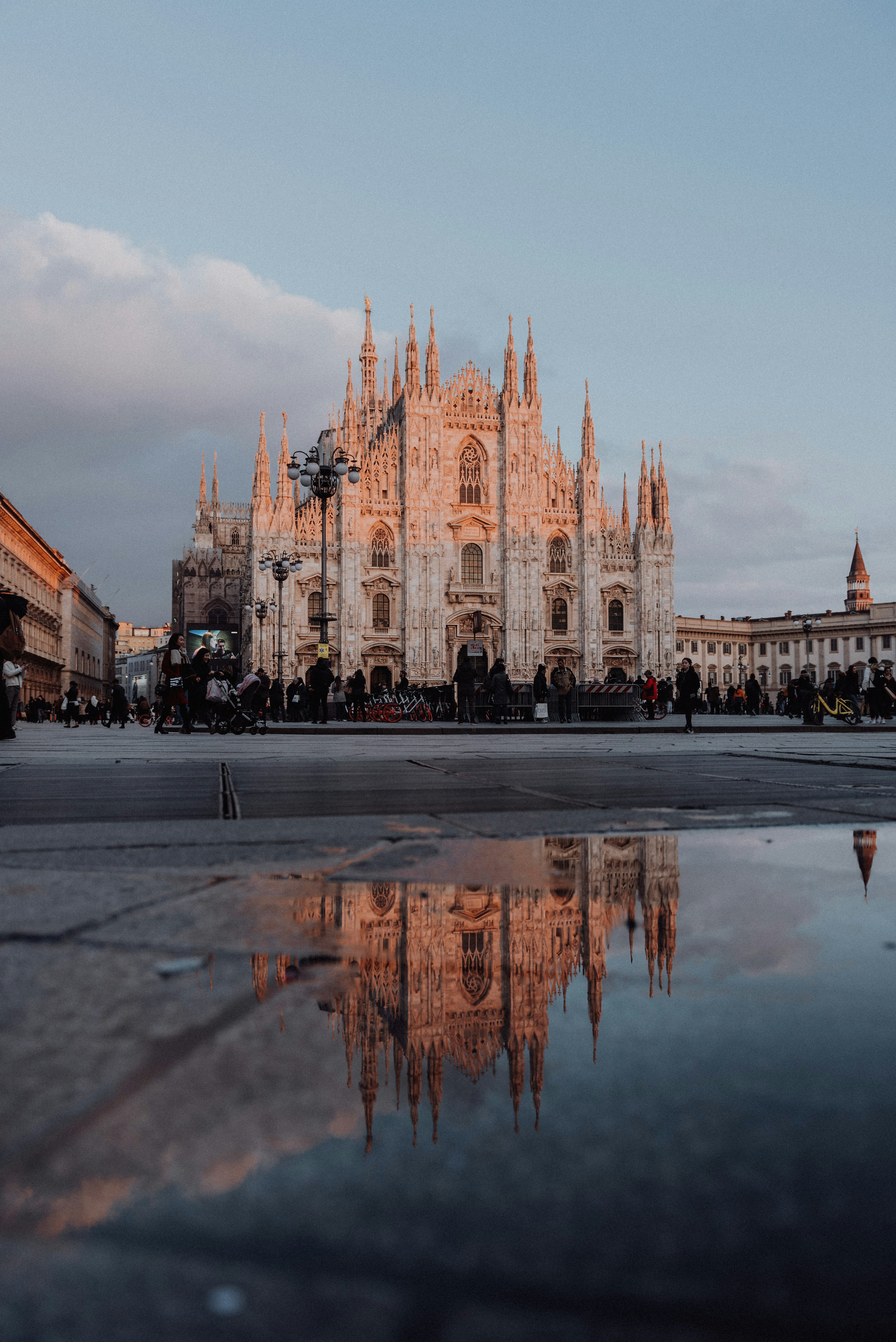
Start at the Duomo. Construction began in 1386 under the Visconti dynasty and took 579 years to complete: the last bronze doors were installed in 1965. There are 3,400 statues on the exterior. The tallest spire rises 108 metres, topped by the gilded copper Madonnina, the Virgin Mary, that has presided over Milan since 1774. For nearly two centuries she was the highest point in the city. When the first building exceeded her height in 1960, the Milanese placed a small replica of the Madonnina on the new building's roof. Technically, the Virgin still presided. The rule was satisfied. The tower was built. Milan has always known how to have it both ways.
Go inside the cathedral. The nave rises 43 metres, one of the highest Gothic vaults ever built. Near the main entrance, find the brass meridian band set into the marble floor: installed in 1786, it was used to synchronise time across the city by projecting sunlight through a hole in the ceiling onto this line at solar noon. A Gothic cathedral that was also a precision scientific instrument. Most visitors walk over it without noticing.
Walk north through the Galleria Vittorio Emanuele II, the glass and iron arcade connecting Piazza del Duomo to Piazza della Scala, completed in 1877. The central octagon has a mosaic floor depicting the coats of arms of Milan, Rome, Florence and Turin. Find the bull of Turin. Spin once on your heel on the bull's genitals. The tradition is unexplained, the marble has been worn into a deep depression and relaid multiple times, and everyone does it.
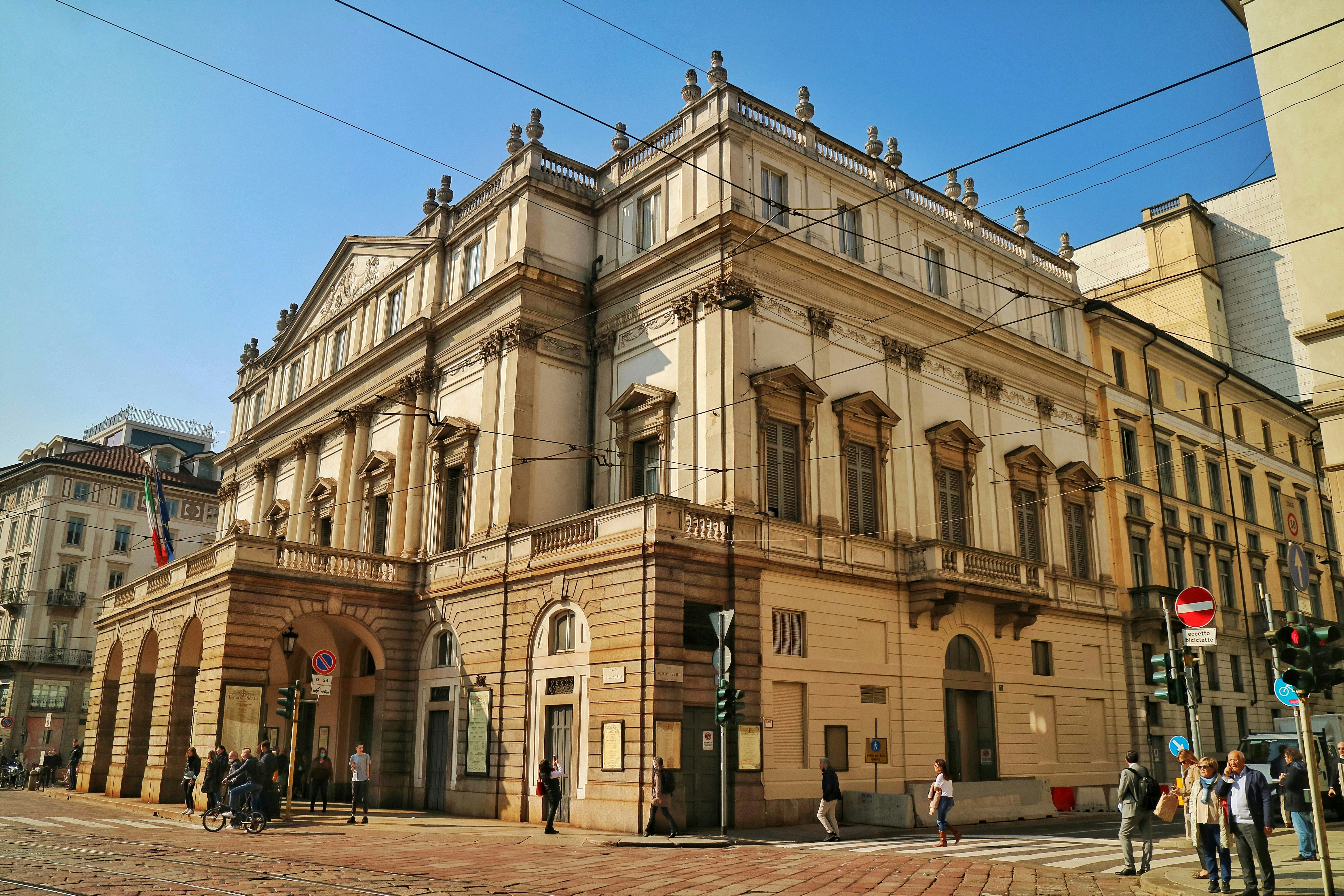
La Scala on Piazza della Scala opened on 3 August 1778 and is one of the most important opera houses in the world. Allied bombing destroyed it in 1943. Milan rebuilt it before almost anything else: it reopened in May 1946, a year after the end of the war, with a concert conducted by Arturo Toscanini. That decision tells you what Milan considers essential.
This is where the Stepcast Milan audio tour begins. It starts at the Duomo and takes you north through the Galleria, La Scala, and the Brera district to San Simpliciano, then west to the Sforza Castle and the extraordinary hidden frescoes of San Maurizio al Monastero Maggiore, and east back through Roman Milan to the medieval Piazza dei Mercanti. The first three stops are free and the full walk takes a comfortable three to four hours at a relaxed pace.
Continue north into Brera. The Palazzo di Brera houses the Pinacoteca di Brera upstairs, one of the finest art collections in Italy, including Raphael's Betrothal of the Virgin and Mantegna's Dead Christ. The courtyard below is free: in the centre stands a bronze statue of Napoleon, entirely nude, that Napoleon himself refused to accept when Canova finished it in 1811. He thought it was too revealing. Wellington later bought it, and eventually it returned to the institution Napoleon had founded. He now stands naked in the courtyard of his own creation. Milan finds this satisfying.
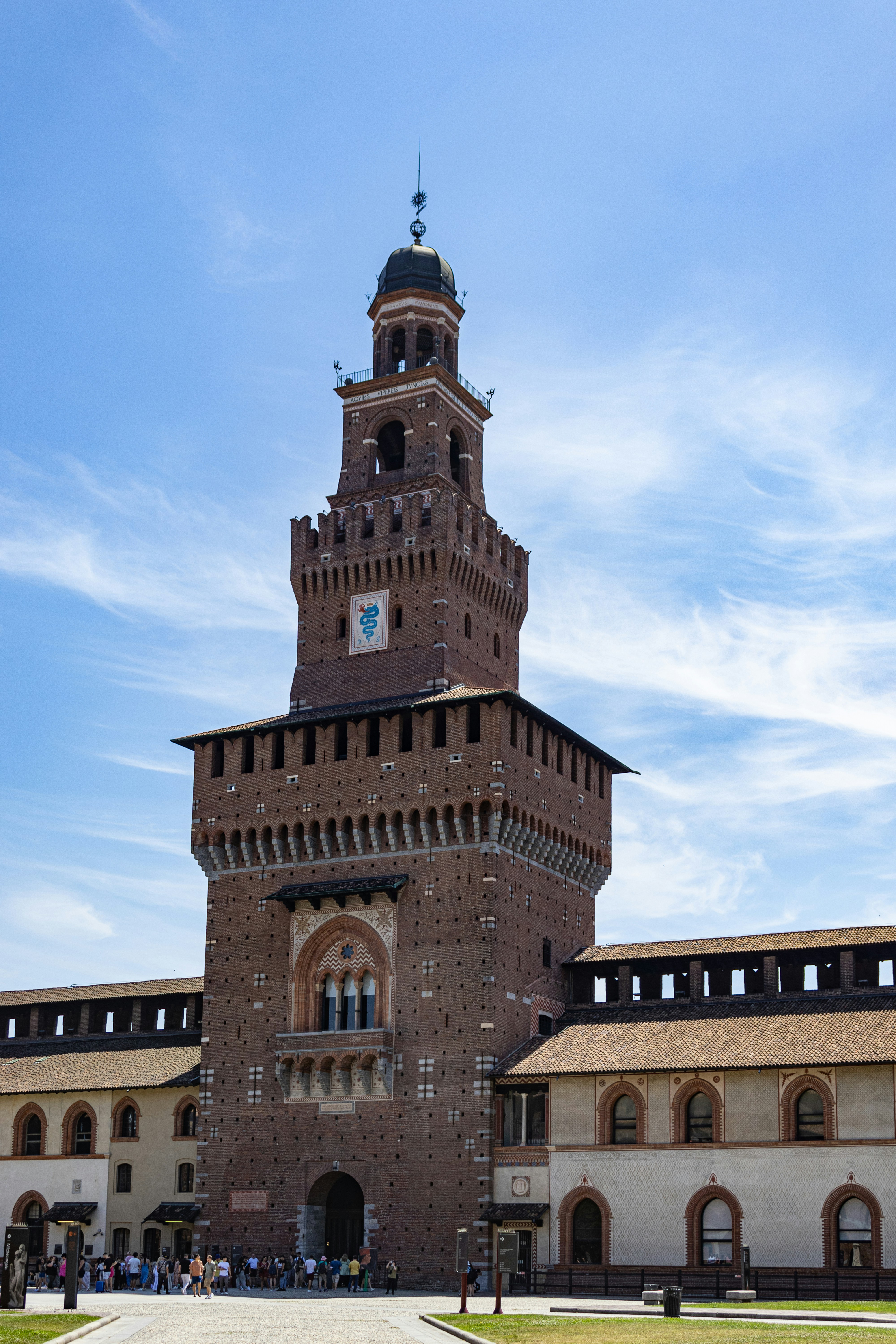
Walk north to San Simpliciano, one of the oldest churches in the city, built by Saint Ambrose in the 4th century. Then head west to the Sforza Castle. Leonardo da Vinci spent seventeen years working for the Sforza court here: his only surviving fresco cycle in Milan is on the ceiling of the Sala delle Asse inside, a trompe l'oeil canopy of mulberry trees painted in 1498.
Inside the Castello, in its own dedicated museum wing, is Michelangelo's Pieta Rondanini: the last work he ever made. He was still working on it six days before his death in 1564. It is one of the most quietly overwhelming things in Milan. Check the official website for current entry prices and opening hours.
For the evening, head back to Brera. The streets around Via Fiori Chiari fill with aperitivo crowds from around 6pm. In Milan, aperitivo is not just a drink: most bars include a spread of food with the price of a Negroni or Aperol Spritz. It is cheaper than a restaurant and considerably more enjoyable.
The Stepcast Milan tour
follows Day 1's exact route.
Duomo, Galleria, La Scala, Brera, Sforza Castle, San Maurizio, Roman Milan, Piazza dei Mercanti. Audio at every stop, go at your own pace. First 3 stops completely free.
Try the Milan tour for free →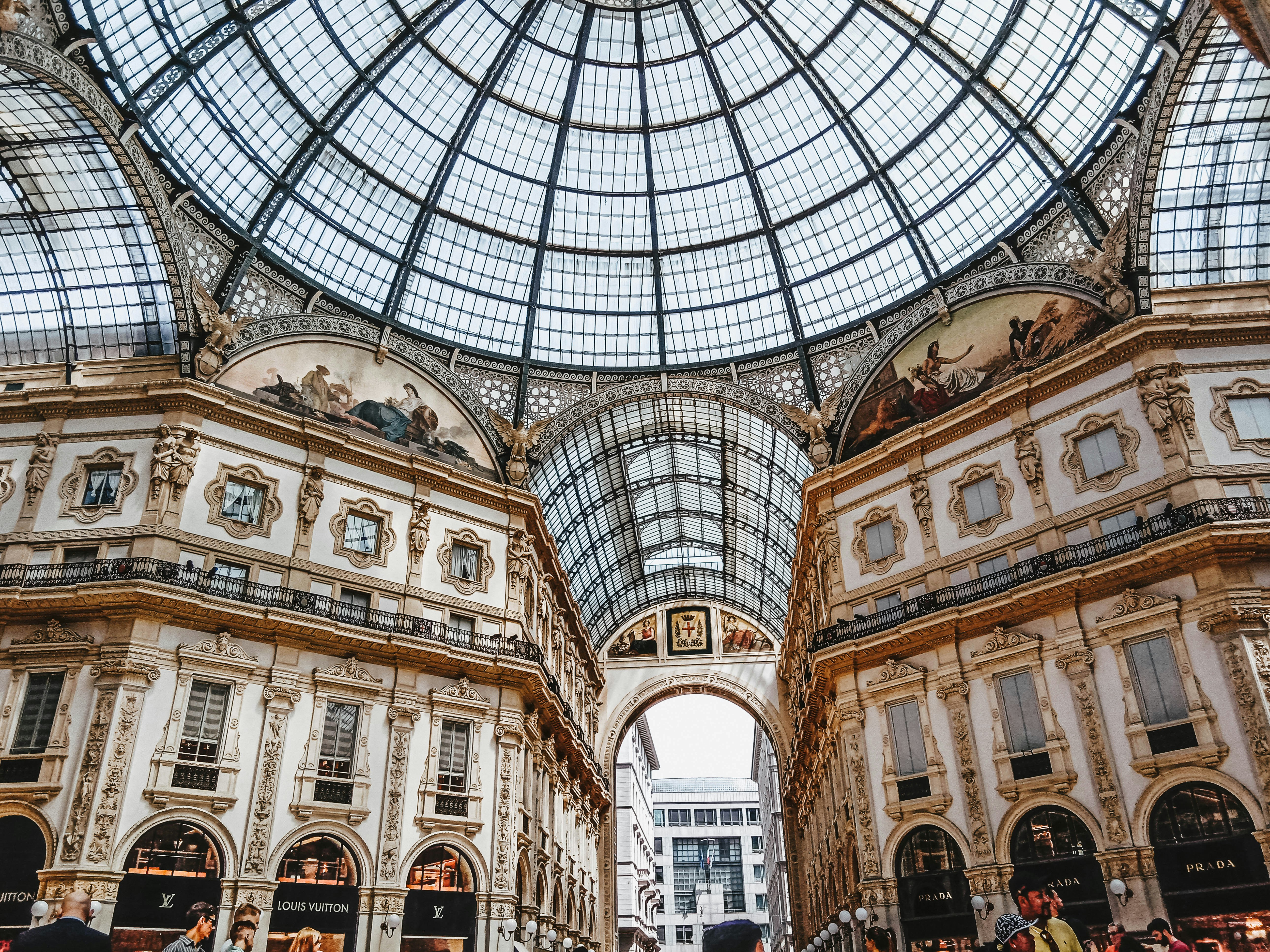
Lake Como:
Varenna and
Bellagio.
Lake Como is 46 kilometres long, shaped like an inverted Y, surrounded by mountains that drop straight into the water. Rather than heading to Como town, take the train directly to Varenna on the eastern shore: a small, steep village that most visitors miss entirely, and the best starting point for a day on the lake.
Take a Trenitalia train from Milano Centrale toward Tirano or Sondrio and get off at Varenna-Esino. The journey takes about an hour and ten minutes. Trains run roughly hourly. The station sits above the village: walk down through the narrow lanes toward the water.
Varenna
Varenna has about 800 inhabitants, no through traffic, and the feeling that the rest of the lake has not quite caught up with it. The Passeggiata degli Innamorati, the Lovers' Walk, is a lakeside path carved into the rock connecting the two ends of the village. It takes about ten minutes to walk from end to end and for most of it you are at water level, with the Alps directly across the lake.
Villa Monastero, built on the site of a former Cistercian convent, has terraced botanical gardens stepping down to the lake. The gardens are worth the entry. Villa Cipressi next door has similar grounds and can be visited together. Above the village, a fifteen-minute climb up through olive groves leads to the Castello di Vezio, a medieval tower with panoramic views over the lake in both directions.
Eat lunch in Varenna before taking the ferry. The restaurants along the lakefront are good and considerably quieter than anything in Bellagio. The afternoon in Bellagio will be busier.
Ferry to Bellagio
The traghetto, the car and passenger ferry, crosses from Varenna to Bellagio in about fifteen to twenty minutes. It runs frequently throughout the day. Standing on the deck as the ferry crosses the centre of the lake, with mountains rising on every side and the village of Bellagio coming into focus at the tip of the promontory, is one of the more straightforwardly beautiful experiences available in northern Italy.
Bellagio sits at the fork where the lake's two southern arms divide. It is the most famous village on Lake Como, and the attention is deserved. The Salita Serbelloni, the steep stepped street running up from the waterfront, has been lined with shops and restaurants for centuries. The gardens of Villa Melzi on the southern shore are open to the public and worth an hour: camellias, azaleas, and a Japanese pond garden laid out along the lakeside in the early 19th century.
Return to Varenna by ferry in the late afternoon and take the train back to Milan. For dinner, go to the Navigli. After two days in the city centre, the canal neighbourhood has a different energy: lower buildings, slower pace, better value.
The Last Supper,
Sant'Ambrogio,
and the Navigli.
Book the Last Supper before you book anything else in Milan. Leonardo da Vinci painted it on the refectory wall of Santa Maria delle Grazie between 1495 and 1498. Entry is limited to 25 people at a time, for 15 minutes per group. Tickets must be booked weeks or months ahead of your visit, and walk-in entry is not possible. Check the official website for current availability and prices, and build your itinerary around whichever slot you can secure.
Leonardo painted it in tempera rather than fresco, an experimental choice that began deteriorating almost immediately. It was damaged further by humidity, a door cut through the lower section in the 17th century, use of the refectory as a stable during the Napoleonic occupation, and Allied bombing in 1943 that destroyed the roof above it while leaving the wall intact. What you see is a work in continuous conversation with its own decay. The faces are still extraordinary.
Tickets are released several months in advance on the official Cenacolo Vinciano website. If your dates are fully booked, try the official phone booking line or look for small group tours that include the entry allocation. Do not leave this until you arrive in Milan.
Sant'Ambrogio
Walk five minutes from Santa Maria delle Grazie to the Basilica of Sant'Ambrogio. This is one of the most important Romanesque churches in Italy and one of the oldest in Milan. Saint Ambrose, the Bishop of Milan who baptised Augustine of Hippo and compelled the Roman Emperor Theodosius to do public penance for a massacre, commissioned the original basilica here in 379 AD. The current structure is primarily 11th and 12th century, built over the foundations he laid.
The atrium in front of the church, with its two-storey portico, is one of the earliest and finest examples of an Italian Romanesque church courtyard. Go inside. The nave has no stained glass: the light is low and even, the columns are massive, and the proportions feel ancient in a way the Duomo, for all its history, does not. There is a golden altar frontal in the apse, the Paliotto d'Oro, made in the 9th century and one of the finest examples of Carolingian goldwork in Europe.
The Navigli
The Navigli are the surviving section of Milan's original canal network. At its peak in the medieval and Renaissance periods, Milan was threaded with navigable waterways connecting the city to the Alps and the Po river. Leonardo da Vinci improved the lock systems for the Naviglio Interno while working at the Sforza court in the late 15th century. Urbanisation covered and filled most of the canals through the 20th century. Two remain open: the Naviglio Grande, dating to 1272, and the Naviglio Pavese.
Walk along the Naviglio Grande from the bridge at Viale Gorizia south toward the Darsena, the old harbour where the canals met. The buildings along the water are low and ochre, the streets narrow, and the atmosphere markedly different from the centre. At the Darsena, rebuilt as a public park and waterfront space, you can see where the canal system once connected to the rest of northern Italy.
From around 6pm, the Navigli transforms into the best aperitivo stretch in Milan. The bars along both canals put out food with every drink, the terraces fill, and the city relaxes in a way that the central neighbourhoods rarely manage. It is a good place to end three days in Milan: loud, unhurried, and entirely local.
Practical things
worth knowing.
Getting there
Milan is served by three airports.
Malpensa (MXP) handles most long-haul and international flights, about 50 kilometres northwest of the city. The best option is the Malpensa Express train, which runs every 30 minutes to Milano Centrale (52 minutes, around €13) and Milano Cadorna (about 30 minutes, same price). Buy tickets at the airport station before boarding. If you are in Terminal 2, take the free shuttle bus to Terminal 1 first: the train only departs from T1.
Linate (LIN) handles many European short-haul routes and is the closest airport to the centre. Metro Line 4 (M4) connects Linate directly to the city: around 12 minutes to San Babila in the centre, on a standard metro ticket (around €2.20). This opened in 2023 and makes Linate by far the easiest airport to arrive at.
Bergamo Orio al Serio (BGY) is the main hub for low-cost carriers including Ryanair. If you are flying from a European city on a budget airline, you will likely land here. Buses run directly to Milano Centrale every 20 to 30 minutes, taking about 50 to 60 minutes depending on traffic, and cost around €5 to €7 one way. Buy tickets from the desk in arrivals or online in advance. A taxi to central Milan from BGY costs around €70 to €90 and is rarely worth it.
By train from other Italian cities: Rome to Milano Centrale takes 3 hours on the Frecciarossa high-speed service. Florence takes under 2 hours. From Paris, the TGV via Turin takes about 7 hours.
Getting around
The Metro has four lines and is clean, fast and well-signed. Buy a single ticket or a 24-hour or 48-hour pass depending on how much you need it. The historic centre and Brera are very walkable. Trams are a pleasant alternative for longer journeys within the ring road.
Aperitivo
In Milan, aperitivo is a serious institution. A drink between roughly 6pm and 9pm typically includes a buffet of food, sometimes generous enough to replace dinner. Brera is the most fashionable area for it. The Navigli is more relaxed and better value. Avoid the centre, where the same tradition is done more expensively to a tourist crowd.
Fashion and design
The Quadrilatero della Moda, the fashion district around Via Montenapoleone and Via della Spiga, is worth a walk even without buying anything: the window displays are extraordinary and the buildings are beautiful. Milan Design Week, the Salone del Mobile, happens in April and turns the whole city into a design event. If you are visiting at any other time, the Triennale di Milano on Viale Alemagna has a permanent design collection and regular temporary exhibitions.
Eating and drinking well
Breakfast: stand at the bar. Every bar in Italy charges more if you sit down. A cappuccino and a cornetto eaten standing at the counter is how Milan actually starts its day, costs almost nothing, and tastes better than anything served at a hotel buffet. Find a bar away from the tourist areas and do not apologise for not speaking Italian.
Luini, Via Santa Radegonda (one minute from the Duomo): panzerotti fritti, half-moon fried dough pockets stuffed with tomato and mozzarella. They have been making them here since 1888. The queue spills onto the street and moves fast. Two or three cost the same as a tourist-area coffee. This is genuinely what Milanese people eat for lunch on a quick day.
What to order in a proper trattoria: risotto alla Milanese, the saffron risotto that is one of the oldest dishes in Lombard cooking, served deep yellow and very rich. Cotoletta alla Milanese, the original breaded veal cutlet, bone-in, fried in butter until the breadcrumbs are dark gold: nothing like what gets called a Milanese cutlet elsewhere. Ossobuco, braised veal shank, traditionally served with the risotto. These are what the city is actually proud of. A place that does them well is a place worth returning to.
Where to eat: leave the Duomo area entirely. The neighbourhoods around Isola (north of Garibaldi station), Porta Romana, and Citta Studi have good local trattorias with handwritten menus and rooms full of people who live nearby. A two-course lunch with wine in any of these areas costs a fraction of what the same food costs in the centre.
Peck, Via Spadari 9 (two minutes from the Duomo): the finest food shop in Milan, open since 1883. The deli counter runs the full length of the ground floor. The cheese, the charcuterie, the prepared dishes. Go in even if you are not buying: it tells you more about how Milan thinks about food than any restaurant can.
Bar Basso, Via Plinio 39: the bar where the Negroni Sbagliato was invented. In the 1970s, bartender Mirko Stocchetto accidentally used Prosecco instead of gin and did not correct the mistake. The drink spread across the world. The bar is still in the same location, still serving it, and still the right place to drink one in Milan. It is not in the centre: take the Metro to Loreto and walk five minutes. Go late, after 9pm, when it is full.
The Cimitero Monumentale in the northwest of the city is one of the most extraordinary cemeteries in Europe, a catalogue of funerary sculpture by leading Italian artists spanning 150 years. It is free to enter and almost always quiet. Allow an hour if you go. It is not on most tourist itineraries. It should be.
Your 3-day Milan
itinerary at a glance.
Walk Milan with
a guide in your pocket.
The Stepcast Milan tour covers the Duomo, Brera, the Castello Sforzesco, and the medieval heart of the city with audio commentary at every stop. No booking, no group, no fixed start time. First 3 stops completely free.
Try the Milan tour for free →